Levels of the Autism Spectrum: What Level 1, 2, and 3 Mean
If you searched for "levels autism spectrum," you are probably trying to turn a confusing set of labels into something practical. The current clinical framework commonly describes three autism spectrum levels: Level 1, Level 2, and Level 3. These levels are about support needs, not intelligence, personality, worth, or a simple "mild to severe" ladder. They also do not include official Level 4, Level 5, Level 7, or Level 8 categories. This guide explains the autism spectrum levels in plain English, including what Level 1 autism symptoms can look like, what Level 2 support may involve, and why Level 3 autism usually means very substantial daily support. For gentle self-reflection before any professional conversation, private autism self-reflection tools can help you organize observations without treating a quiz result as a final answer.
Quick Answer: There Are Three Autism Spectrum Levels
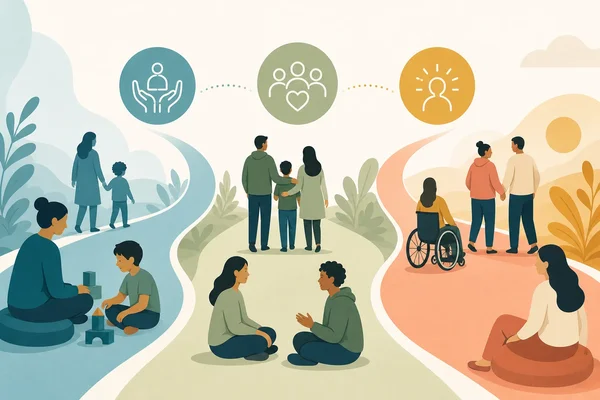
The three levels describe how much support a person may need in two broad areas: social communication and restricted, repetitive patterns of behavior, interests, sensory responses, or flexibility. A clinician may also consider language, learning profile, co-occurring conditions, daily living skills, and how the person functions across home, school, work, or community settings.
| Autism spectrum level | Plain-English meaning | Support focus |
|---|---|---|
| Level 1 | Requires support | Social communication, planning, transitions, sensory needs, and daily-life accommodations may be important even when traits are less visible. |
| Level 2 | Requires substantial support | Communication differences and flexibility challenges are more apparent and often need consistent, structured support. |
| Level 3 | Requires very substantial support | Communication access, daily living support, safety, sensory regulation, and intensive individualized help may be central. |
The levels are not a complete portrait of a person. Someone can communicate fluently and still need support with sensory overload, executive functioning, or recovery after social demands. Someone else may use few spoken words yet understand far more than outsiders assume. The point of a level is to guide support, not to reduce a person to a number.
Autism Levels Chart: Support Needs, Not Human Value
An autism levels chart is most useful when it is read as a support map. It should help you ask, "What makes daily life easier, safer, clearer, or more accessible?" It should not be used to rank people from "better" to "worse."
The same person may also look different across settings. A quiet home environment, predictable routine, trusted communication partner, or sensory-friendly workplace can reduce support needs. A loud event, sudden change, medical stress, burnout, or heavy masking can make the same person appear to need much more help. This is one reason labels such as "high-functioning" and "low-functioning" can be misleading. They often describe what outsiders notice, not what the person is carrying.
Use this quick reflection when reading any autism spectrum levels chart:
- What support does the person need for communication?
- What support helps with change, transitions, routines, or sensory input?
- Which settings increase or reduce stress?
- What strengths are easy to miss when only challenges are listed?
- What accommodations would make participation more realistic?
This keeps the chart practical and humane. It also makes room for adults who have spent years camouflaging autistic traits and may not recognize their support needs until exhaustion, anxiety, or burnout makes them harder to ignore.

Level 1 Autism Symptoms: Support May Be Less Visible
Level 1 autism is often described as "requiring support." In everyday life, that can mean a person speaks fluently, studies, works, parents, or lives independently, while still finding certain social, sensory, or planning demands unusually draining.
Common Level 1 autism symptoms may include difficulty starting or sustaining back-and-forth conversation, uncertainty about social rules, intense interests, strong preference for routine, sensory sensitivities, and challenges with organization or task switching. In adults, these traits may be hidden by learned scripts, careful planning, or social masking. A person may appear composed in public and then need a long recovery period afterward.
Level 1 does not mean "barely autistic." It means support may be more targeted or less obvious. Examples include written instructions, predictable schedules, flexible work arrangements, sensory breaks, direct communication, therapy for co-occurring anxiety, or help translating personal needs into accommodations.
This is where an adult trait exploration hub can be useful as a private first step. It cannot assign an autism level, but it may help someone notice patterns such as masking, sensory strain, social fatigue, or difficulty recovering from everyday demands.
Level 2 Autism: What "Substantial Support" Can Mean
Level 2 autism means substantial support is likely needed. Social communication differences may be noticeable even when support is already in place. A person may use shorter phrases, communicate in ways others do not immediately understand, struggle with back-and-forth conversation, or need extra time and structure to process social information.
Restricted or repetitive behaviors, sensory needs, and difficulty with change may also interfere with daily life in multiple settings. Unexpected schedule changes, noisy environments, unclear instructions, or transitions between activities can be especially hard. Support may include speech-language services, occupational therapy, visual schedules, augmentative and alternative communication, structured routines, educational accommodations, caregiver coaching, or workplace and community supports.
So, is Level 2 autism high-functioning? That phrase is not a reliable fit. Some Level 2 autistic people have strong academic, creative, technical, memory, or pattern-recognition skills. They may also need substantial help with communication access, daily routines, emotional regulation, or sensory load. A support level should make needs clearer, not hide them behind a flattering or limiting label.
Level 3 Autism: Very Substantial Support and Communication Access
Level 3 autism means very substantial support is likely needed across major parts of daily life. Communication may be limited, inconsistent, nonspeaking, or dependent on alternative methods such as AAC, gestures, pictures, typing, signs, or trusted communication partners. Social initiation and response may be difficult to see from the outside, especially when the person is overwhelmed.
Behavioral flexibility and sensory regulation may also be major support areas. Changes in routine, transitions, pain, sleep disruption, crowded spaces, or unclear expectations can create intense distress. Support may focus on communication access, safety, daily living skills, sensory-friendly environments, predictable routines, and respectful help from family members, educators, clinicians, or support workers.
Level 3 does not mean a person lacks understanding, preferences, relationships, humor, or agency. It means the environment and support plan must work much harder to meet the person where they are. The most helpful question is not "How severe is this person?" but "What access, communication, and daily support does this person need to be safer and better understood?"
Why Searches Mention Level 4, Level 5, Level 7, or Level 8
Many searches ask about "what are the 5 levels of autism," "autism level 4 symptoms," or even "autism spectrum level 8." These phrases usually come from mixed information online. The current mainstream autism support-level framework uses three levels, not five, seven, or eight.
Some confusion comes from older terms that were once treated as separate autism-related categories, such as Asperger's syndrome, autistic disorder, PDD-NOS, and childhood disintegrative disorder. Many of those labels were folded into the broader autism spectrum framework in modern clinical language. Other confusion comes from service systems, school support categories, severity scales, IQ or language labels, or informal internet charts.
The phrase "7 types of autism" is also not a standard current way to explain autism. It may refer to older labels, co-occurring conditions, support styles, or content written for search traffic rather than clinical clarity. If you see a chart with more than three autism spectrum levels, check what it is actually measuring. Is it support need, communication style, sensory profile, learning needs, service intensity, or something else?
The same caution applies to celebrity examples and public figures linked with Asperger's. A public label does not tell you someone's support level. Career success, wealth, public speaking, or media confidence can coexist with support needs that are private, masked, or context-specific.
How to Use Autism Spectrum Levels Gently
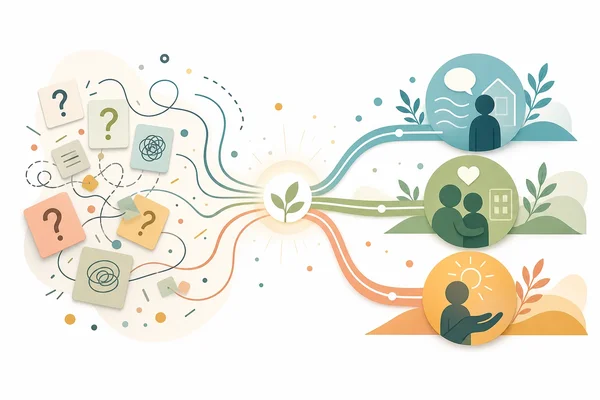
The most respectful way to use autism spectrum levels is to treat them as a conversation starter about support. If you are reflecting on yourself, a child, a partner, or a client, avoid asking, "Which level is worse?" Try asking:
- What settings are hardest?
- What communication supports help?
- What sensory inputs are painful, calming, or distracting?
- What routines make the day more predictable?
- What support is needed when stress is high, not only on a good day?
- What strengths should be protected while support needs are addressed?
If you are exploring your own traits, keep notes about patterns across time. A quiz, journal, or article can help you organize language, but it should not replace a qualified professional assessment when you need formal documentation, services, or care planning. AutisticQuiz.com is built around that gentler boundary: insight first, not certainty. You can use gentle autistic quiz resources to reflect on traits, masking, and next-step questions at your own pace.
FAQ
How many levels of autism spectrum are there?
The current support-level framework commonly uses three autism spectrum levels: Level 1 requiring support, Level 2 requiring substantial support, and Level 3 requiring very substantial support. These levels describe support needs, especially around social communication and restricted or repetitive patterns of behavior, sensory responses, and flexibility.
What are the 5 levels of autism?
There are not five official autism spectrum support levels in the mainstream DSM-5 framework. Searches about five levels often mix older autism-related labels, service categories, severity language, or internet charts. For clear everyday understanding, use the three support levels and then look at the person's individual strengths, communication style, sensory needs, and environment.
Is Level 2 or Level 3 autism worse?
Level 3 usually means more intensive support needs than Level 2, but "worse" is not a helpful word. Autism levels are not moral rankings or predictions of someone's potential. They are support descriptors. A better question is what type of help the person needs to communicate, participate, regulate sensory input, manage transitions, and stay safe.
Is Level 2 autism high-functioning?
Usually, "high-functioning" is too vague for Level 2 autism. Level 2 means substantial support is needed, even if the person also has strong abilities in some areas. Instead of using a functioning label, describe the specific support needs: communication, routines, sensory environment, daily living, school, work, relationships, or emotional regulation.
What are the 7 types of autism?
"Seven types of autism" is not a standard current framework. Older labels, co-occurring conditions, learning profiles, and support needs are sometimes grouped in different ways online. Modern language usually treats autism as a spectrum and then describes support level, language profile, intellectual or learning differences, sensory needs, and co-occurring conditions separately.
What is 90% of autism caused by?
This question often refers to genetic influence estimates from family and twin research. It is more accurate to say that autism has a strong genetic component and is also shaped by complex biological and environmental factors. A percentage does not mean one simple cause explains every autistic person, and it should not be used to blame parents or reduce autism to a single factor.
Which billionaire has Asperger's, and does that tell us an autism level?
Some public figures have spoken about Asperger's or autism-related identity, and people often bring those examples into search questions. They do not tell us how autism spectrum levels work. Public success does not reveal someone's private support needs, and an older Asperger's label does not automatically translate into Level 1, Level 2, or Level 3.