Is Autism More Common in Boys or Girls? The Real Gender Gap
For decades, the standard answer has been simple: autism is much more common in boys, with a widely cited ratio of 4 to 1. If you are an adult woman or someone who doesn't fit the stereotypical "boy" profile, this statistic might make you feel invisible. You may wonder if your struggles are valid or if you have simply slipped through the diagnostic cracks.
This article explores whether autism is truly biologically rare in females or just harder to spot. We will break down the latest global statistics, examine the "Female Protective Effect" theory, and reveal how diagnostic bias and masking behaviors skew the numbers. By the end, you will understand the real gender gap and how to safely explore your own traits using a reliable autism test online.
The Official Numbers: Analyzing Male vs. Female Diagnosis Rates
When you search for autism statistics, you almost always encounter a significant gender disparity. Officially, autism is diagnosed far more frequently in males than in females. However, understanding these numbers requires looking beyond the surface level of simple ratios.
Current Global Prevalence and Ratios
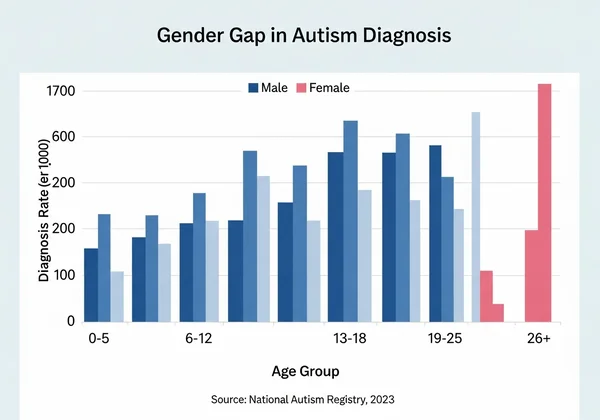
According to data from the Centers for Disease Control and Prevention (CDC), about 1 in 36 children in the U.S. has been identified with autism spectrum disorder (ASD). Within this group, the diagnosis is roughly four times more common among boys than girls. Similar trends appear globally, though some recent studies suggest the true ratio might be closer to 3:1 when active screening is involved rather than just passive diagnosis.
These numbers reflect diagnosed cases, not necessarily the actual number of autistic people. The gap is narrowing slowly as awareness grows, but the historical data still leans heavily toward males.
Why Statistics May Not Tell the Whole Story
Ratios like 4:1 or 3:1 are snapshots of clinical practice, not biological absolute truths. They rely on who gets referred for assessment and who meets the criteria during that assessment.
Historically, autism research focused almost exclusively on boys. This means the diagnostic criteria were built around male behaviors. As a result, many females who are autistic but present differently are missed in these official counts. The statistics you see today are a mix of biological reality and systemic oversight.
Biological Factors: Why Males Are Diagnosed More Frequently
While diagnostic bias plays a huge role, scientific research suggests there are also biological reasons for the gender gap. It is not just about who doctors notice; it is also about how genetics and brain development differ between sexes.
The "Female Protective Effect" Theory Explained
One leading scientific theory is the Female Protective Effect (FPE). This hypothesis suggests that females need a higher "load" of genetic mutations to reach the threshold for an autism diagnosis. In other words, a girl might have the same genetic risk factors as a boy but not show the same level of autistic traits due to some inherent biological protection.
This theory implies that when girls are diagnosed, they often have more severe symptoms or co-occurring conditions, simply because it took a greater genetic impact to cross that diagnostic threshold.
Genetic Differences and Brain Development
Research into brain structure also points to differences. Studies have shown that the brains of autistic males and females can develop differently. For example, some genetic markers associated with autism appear more frequently or act differently in males.
Hormonal factors, such as exposure to fetal testosterone, have also been studied as potential contributors to the higher prevalence in boys. These biological factors suggest that even in a perfectly unbiased world, there might still be some gender difference in prevalence, though likely much smaller than the current 4:1 gap suggests.
The "Hidden" Autistics: Is Autism Really Rare in Girls?

If biology explains part of the gap, the rest is likely explained by who we are missing. For many women and non-binary individuals, autism isn't rare—it is just hidden. This section explores why so many people go undiagnosed until adulthood.
Understanding Diagnostic Bias: Are the Criteria "Male-Centric"?
The standard diagnostic criteria for autism often emphasize behaviors like repetitive movements (rocking, flapping) and intense interest in mechanical objects (trains, numbers). While many autistic girls do have these traits, they often present more subtly.
Clinicians are trained to look for these specific "male" markers. If a girl makes eye contact (even if forced), has friends (even if she mimics them), or has a special interest in "acceptable" topics like literature or animals, she is less likely to be flagged for autism. This systemic bias means the "filter" for diagnosis catches boys much more easily than girls.
The Phenomenon of Masking (Camouflaging)
Masking, or camouflaging, is the act of consciously or unconsciously suppressing autistic traits to fit in. While all genders mask, research shows that females tend to do it more frequently and effectively.
Masking is a survival strategy. It involves observing social interactions like an anthropologist and then performing a "normal" persona. This constant effort allows many autistic women to fly under the radar at school and work, but it often leads to severe burnout and anxiety behind closed doors. Because they appear to function well socially, their autism remains invisible to doctors and families.
Checklist: Common Signs of High-Masking Behaviors
If you suspect you might be a high-masking individual, look for these common signs that standard checklists often miss:
- Forced Eye Contact: You look people in the eye because you know you "should," not because it is natural. You might look at their nose or eyebrows instead.
- Scripting Conversations: You rehearse what you are going to say before a phone call or social event, or you rely on "scripts" from movies or books during small talk.
- Social Exhaustion: You can socialize successfully, but you need hours or days of solitude to recover afterward.
- Mimicking Peers: You consciously copy the gestures, tone of voice, or fashion of popular peers to avoid standing out.
- Suppressing Stims: You hide repetitive movements (like hand flapping) in public or replace them with more socially acceptable ones (like leg bouncing or pen clicking).
Symptom Presentation: Stereotypes vs. Reality
To understand if autism is more common in boys or girls, we must look at how symptoms manifest differently. The core traits are the same, but the expression often varies.
Externalizing (Boys) vs. Internalizing (Girls) Behaviors
Generally speaking, boys are more likely to show externalizing behaviors. This includes acting out, aggression, or obvious hyperactivity. These behaviors are disruptive, so they get noticed by teachers and parents quickly.
Girls, conversely, often show internalizing behaviors. Their distress turns inward. This manifests as anxiety, depression, eating disorders, or extreme perfectionism. A quiet, anxious girl who gets good grades is rarely flagged for an autism assessment, even if she is struggling internally just as much as the disruptive boy.
Special Interests: Mechanical vs. Relational Topics
Special interests are a hallmark of autism. The stereotype is a boy obsessed with train schedules or math. While this exists, it is not the only way special interests appear.
Autistic girls often have intense interests in topics that seem "neurotypical" but differ in intensity.
- Stereotype: Collecting train parts.
- Reality for many girls: An obsession with a specific band, a deep knowledge of a fictional universe (like Harry Potter), a fascination with psychology, or a love for animals.
Because these interests (pop culture, animals, psychology) are socially acceptable for girls, they aren't seen as "odd" or autistic, further delaying diagnosis.
Visual Guide: How Traits Manifest Differently
| Trait | "Classic" Presentation (Often Male) | "Masked" Presentation (Often Female) |
|---|---|---|
| Social | Little interest in peers; plays alone. | Desires friends; mimics others to fit in; "hovers" on the edge of groups. |
| Repetitive Behavior | Rocking, hand flapping, spinning objects. | Skin picking, hair twirling, leg bouncing, perfectionism. |
| Interests | Objects, mechanics, dates, numbers. | Psychology, literature, animals, celebrities, fantasy worlds. |
| Response to Overwhelm | Meltdowns (screaming, crying). | Shutdowns (going silent, withdrawing, dissociating). |
From Statistics to Self-Discovery: Exploring Your Traits

Understanding the gender gap is intellectual; realizing you might be part of the "hidden" statistics is personal. If the descriptions of masking and internalized symptoms resonate with you, you may be wondering what to do next.
Why Many Adults Are Diagnosed Later in Life
It is increasingly common for adults—especially women and gender-diverse individuals—to discover their autism in their 20s, 30s, or beyond. Often, this happens after a lifetime of feeling "different" or "broken" without knowing why. Alternatively, many parents recognize their own traits while going through the diagnosis process for their children.
Receiving a late diagnosis (or self-identifying) can be a relief. It reframes past struggles not as personal failures, but as differences in how your brain is wired.
Using Educational Tools for Insight (Not Diagnosis)
If you are curious about where you stand, you don't have to wait for a clinical appointment to start exploring. Educational screening tools can provide a helpful baseline.
We invite you to explore our autism test, which is designed to be sensitive to the nuances of adult autism, including those high-masking traits that traditional assessments might overlook.
- For High Maskers: If you identified with the masking section above, consider tools specifically capable of flagging camouflaging behaviors.
- For General Insight: A broad spectrum test can help you see which traits you align with.
Note: These tools are for educational purposes and self-reflection only. They cannot provide a medical diagnosis, but they are an excellent first step in your journey of self-discovery.
Embracing Neurodiversity, Regardless of Gender
Whether autism is statistically more common in boys or just more easily spotted in them, the reality for you as an individual is what matters. The gender gap is narrowing as we learn more about how diverse the spectrum truly is.
- Key Takeaway: Autism is not a "boy's condition." It affects people of all genders.
- Validate Your Experience: If you struggle with social exhaustion, sensory overwhelm, or the need to mask, your experience is real, regardless of diagnostic statistics.
- Next Steps: Use reliable information and screening tools to understand yourself better. For further reading, you can check our guide on how autism test results explained can help interpret your traits.
You deserve to understand your own mind. By looking past the stereotypes, you can find the answers and community you have been missing.
Frequently Asked Questions
Do diagnostic criteria favor male symptoms?
Yes, historically they do. The criteria were originally developed based on studies of boys. Traits like social mimicry or internalized anxiety, which are more common in girls, are often missed by standard criteria that focus on external behaviors.
Can boys have "female" autism traits?
Absolutely. Terms like "male" and "female" autism describe patterns, not strict rules. Many boys and men have internalized symptoms, mask heavily, or have social-focused special interests. They face the same risk of being undiagnosed as women do.
What gender is autism most common in?
Statistically, autism is diagnosed more often in males (about 4 boys for every 1 girl). However, experts believe the true ratio is likely smaller (closer to 3:1) because many females are currently undiagnosed.
Is there a specific age when the gender gap disappears?
The gap doesn't disappear, but it narrows significantly in adulthood. As women get older, they often seek their own answers after burning out from masking, leading to a surge in late-in-life diagnoses for females compared to males.
Why is autism often called a "spectrum"?
It is called a spectrum because there is no single way to be autistic. The "spectrum" isn't a line from "a little autistic" to "very autistic." It is a collection of traits (sensory processing, social communication, motor skills) that vary in intensity for every person, regardless of gender.