AuDHD Explained: How an Autistic Quiz Helps Untangle Autism and ADHD Overlap
Are you navigating a confusing maze of traits, wondering if it's ADHD, autism, or a blend of both? Many adults feel this way. Taking an autistic quiz for adults can clarify these patterns. You might find yourself craving deep, structured routines but struggle to maintain them. Or perhaps you feel exhausted from trying to keep up in social situations, unsure if it’s due to social anxiety or misreading cues. This experience of overlapping symptoms can make self-understanding a challenging journey.
If you’re exhausted from juggling these contradictions, you’re not alone. Let’s unpack AuDHD together. We'll explore the common intersection of autism and ADHD, often called AuDHD. By untangling these complex neurodivergent traits, you can find a clearer path toward self-awareness. If you’re questioning whether your traits align with autism, a confidential autistic quiz can help you explore your traits and provide valuable insights.
This article will break down what AuDHD is, how its traits appear in adults, and how you can begin the process of differential self-assessment.

Understanding the Autism ADHD Overlap: What is AuDHD?
For a long time, autism and ADHD (Attention-Deficit/Hyperactivity Disorder) were seen as completely separate. However, we now understand they can, and frequently do, co-occur. When an individual has significant traits of both autism and ADHD, the community often uses the term "AuDHD" to describe this unique neurotype.
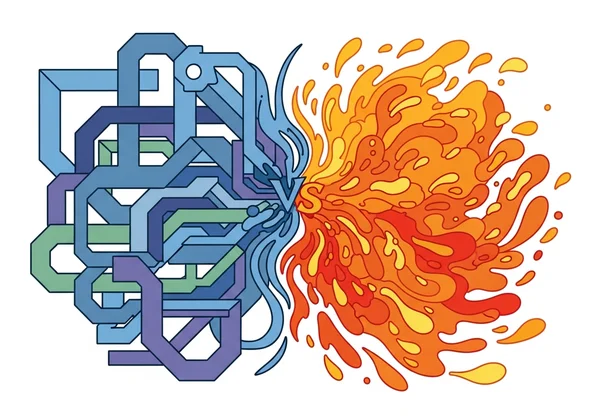
It's not simply having two separate conditions side-by-side. Instead, the traits interact, creating a distinct and often contradictory experience. Imagine having one foot on the gas (ADHD's impulsivity and need for stimulation) and the other on the brake (autism's need for predictability and routine). This internal conflict can be confusing and exhausting, but understanding its source is the first step toward managing it.
Shared Experiences: Executive Dysfunction and Sensory Sensitivity
Two of the most significant areas of overlap in AuDHD are executive dysfunction and sensory sensitivity. While they appear in both conditions, their expression can be unique when combined.
Executive Dysfunction refers to challenges with the brain's "management" skills, such as planning, organizing, starting tasks, and regulating emotions.
- In ADHD: This often looks like procrastination, losing track of time, and difficulty finishing projects due to distraction or boredom.
- In Autism: This can manifest as difficulty with change, trouble transitioning between tasks, and a rigid adherence to plans.
- In AuDHD: You get a complicated mix. You might meticulously plan a project down to the smallest detail (autistic trait) but be completely unable to start it (ADHD trait). This can lead to a frustrating cycle of ambition and paralysis.
Sensory Sensitivity involves being over- or under-responsive to sensory input like sounds, lights, textures, or smells.
- In Autism: This often leads to sensory avoidance. An autistic person might wear noise-canceling headphones or avoid crowded places to prevent overwhelming sensory input.
- In ADHD: This can look like sensory-seeking behavior. An individual with ADHD might need loud music to focus or constantly fidget to get physical input.
- In AuDHD: This creates conflicting needs. You might crave the stimulation of a concert but become completely overwhelmed by the lights and sounds once you're there.
Divergent Origins: Where the Traits Differ
Even when behaviors look similar on the surface, the reasons behind them can differ. Understanding these origins is key to untangling AuDHD. A classic example is the difference between an autistic special interest and ADHD hyperfocus.
An autistic special interest is a deep, passionate, and long-lasting engagement with a specific topic. It's a core part of an individual's identity and brings immense joy and comfort. It's about the depth of knowledge and the love of the subject itself.
ADHD hyperfocus, on the other hand, is an intense state of concentration where the world fades away. While it can be directed toward a passion, it can also be triggered by any novel or highly stimulating task, including video games or falling down an internet rabbit hole for hours. It's more of a state of attention regulation (or dysregulation) than a specific passion.
Social interaction is another key area. An autistic person might avoid social events because they find interpreting body language and unspoken rules exhausting and confusing. Someone with ADHD might avoid the same event because they fear they'll be too impulsive, interrupt others, or become too bored to stay engaged. The AuDHD individual might experience both simultaneously.
Using an Autistic Quiz to Spot AuDHD Patterns
Recognizing AuDHD in adults can be tricky, especially since many have spent a lifetime developing coping mechanisms. However, certain patterns often emerge that highlight the interplay between autistic and ADHD traits. If you're wondering if this describes you, seeing your own experiences in a structured way can be helpful. A preliminary autistic traits quiz can help you identify specific patterns to reflect on.
Social Communication: Masking, Misinterpretation, and Hyperactivity
Social situations are often where the AuDHD conflict is most apparent. Autistic masking (or camouflaging) is the conscious or unconscious effort to hide autistic traits to fit in. This involves manually calculating eye contact, mimicking facial expressions, and scripting conversations. It is incredibly draining, and an autistic masking quiz can help identify these hidden efforts.
ADHD impulsivity might lead you to interrupt mid-sentence—even when you’re carefully ‘scripting’ conversation. Add inattention into the mix, and staying on track feels impossible. For AuDHD individuals, this social balancing act drains energy fast, often resulting in profound social burnout where even simple interactions feel like running a marathon.
Emotional Regulation: Intense Feelings and Rejection Sensitivity
Both autism and ADHD can lead to intense emotional experiences. For AuDHD individuals, this is often amplified. Many people with ADHD experience something called Rejection Sensitive Dysphoria (RSD). This is not a formal diagnosis but describes an extreme emotional pain in response to perceived criticism or rejection.
For an AuDHD person, this can be especially challenging. The autistic side may struggle to interpret social cues, leading to frequent worry about whether they've said or done the "right" thing. This uncertainty feeds the ADHD-related RSD, creating a powerful cycle of social anxiety and emotional distress. An innocent comment from a friend can feel like a devastating critique, causing an intense emotional reaction that seems out of proportion to others.
How Autistic Quizzes Support Differential Self-Assessment
If you relate to these experiences, you may be wondering how to figure out what's going on. This process of telling the difference between conditions is called differential assessment. While a formal diagnosis must come from a qualified professional, your own journey of self-assessment is a valid and important first step. An autistic quiz can be an excellent starting point.
The Role of Online Quizzes in Your Journey
Let's be clear: an online autistic quiz cannot diagnose you with autism, ADHD, or AuDHD. A formal diagnosis is a comprehensive process conducted by a healthcare professional.
However, scientifically-backed screening tools can be an incredibly valuable part of your self-discovery. They serve several key purposes:
- Provide Structure: They give you a structured way to review your life experiences and traits.
- Offer Language: They can give you the vocabulary to describe feelings and challenges you've never been able to put into words.
- Identify Patterns: Seeing your scores can help you recognize patterns that point toward certain neurotypes.
- Build Confidence: The results can validate your feelings and give you the confidence to take the next step, whether that's further research or seeking professional advice.
Taking a confidential quiz designed to explore autistic traits is a low-pressure way to gather information. It can help you see if your experiences align with the autistic side of the AuDHD profile. To try our autistic quiz and take a first step on this path, you can use a free online assessment.

When to Seek Professional Evaluation for an AuDHD Diagnosis
Self-assessment is empowering, but sometimes professional guidance is necessary. If your traits are causing significant distress or interfering with your daily life—at work, in relationships, or with your mental health—it may be time to seek a formal evaluation.
A neurodivergence specialist can assess overlapping symptoms and guide you toward strategies. Bring your autistic quiz results to the session—they’re a great starting point for the conversation.
Your Journey of Self-Discovery with AuDHD Traits
Understanding the autism ADHD overlap is about more than just labels. It's about seeing yourself clearly, perhaps for the first time. Recognizing that your brain is uniquely wired with a blend of traits can be incredibly validating. It explains the contradictions and internal conflicts you may have lived with your entire life.
This journey of self-discovery empowers you to find strategies that work for your specific brain. Instead of fighting against yourself, you can learn to work with your natural tendencies, harnessing your strengths and supporting your challenges.
Imagine finally understanding why you burn out at parties—even if you love dancing. Our autistic quiz can uncover these hidden patterns. Taking this confidential and insightful autistic quiz is a powerful first step on your path to self-understanding. Start your autistic quiz today to gain clarity and begin your journey.
Questions & Answers
Am I autistic if I also have ADHD symptoms?
It's very possible to be both autistic and have ADHD. This is often referred to as AuDHD. The conditions frequently co-occur, and their traits can interact in complex ways. Having symptoms of both doesn't mean one cancels out the other.
How do I know if my traits are from autism, ADHD, or both?
Untangling the "why" behind your behavior is key. For example, do you struggle in social settings because you can't read cues (often associated with autism) or because you get bored and impulsive (often associated with ADHD)? Answering these questions can be difficult alone. A professional can help, but tools like a structured autistic quiz can provide initial clues by focusing specifically on autistic traits.
What are the signs of AuDHD in adults?
Common signs include a constant feeling of being at war with yourself, such as needing routine but being unable to stick to one. Other signs are intense emotional responses, chronic burnout from social masking, and extreme executive dysfunction that affects both planning and execution.
Can an online quiz tell me if I have AuDHD?
While online quizzes can’t diagnose AuDHD, they can highlight autistic traits in the overlap. Consider it your first step toward clarity.
What should I do after taking an autistic or ADHD quiz?
After taking an autistic quiz, take some time to reflect on your results. Do they resonate with you? Read articles from trusted sources and listen to the experiences of other AuDHD individuals. If your results cause you concern or you feel you need more support, consider discussing them with a therapist or doctor who has experience with adult neurodivergence.